
A Story Nearly Two Centuries
in the Making

St. Anne's Aigburth, ca. 1910
Period colourised postcard published by M. Richardson, Aigburth Post Office.
From the St. Anne’s archive.
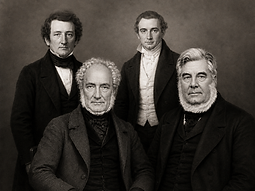
St. Anne’s has stood at the heart of Aigburth since 1837, long before the area became the vibrant Liverpool suburb we know today. When the church was first built, much of the surrounding landscape was open countryside, dotted with large houses, farms and fields. Four local merchants - John Moss, Charles Stewart Parker, John Abraham Tinne and Josias Booker - recognised the need for a parish church that would serve both the growing community and those who worked within it, and together they funded the creation of St. Anne’s.
Designed by Liverpool architects Cunningham and Holme, St. Anne’s was built in an impressive Norman Revival style, with its distinctive stone tower, round arches and strong, solid character. Today it is recognised as a Grade II* listed building, reflecting its architectural and historical importance.
As Aigburth grew, so did the church. New transepts and a larger chancel were added in the 1850's, and further extensions followed in the early twentieth century, allowing St. Anne’s to continue serving an expanding congregation.

Interior of St. Anne's, ca. 1870
Digitally restored from the original print.
The earliest known photograph of the church interior, from the St. Anne’s archive. Photographer unknown.
The stone pulpit and font installed in 1869 are visible, together with the earlier chancel arrangement.
The church has witnessed some remarkable moments in history.
The Suffragette Arson Attack of 1913
On the night of 16 December 1913, during the campaign for women's suffrage, St. Anne’s was damaged in an arson attack carried out by militant suffragettes. In a dramatic episode that reflected the social and political tensions of the era, the pulpit and choir stalls were destroyed and the recently installed Willis organ badly damaged. The church was repaired and continued its ministry, becoming part of the story of a nation undergoing profound change.
The Willis Organ and the Brocklebank Memorial
First installed in 1913 by the famous organ builder Henry Willis, St. Anne’s organ carries a storied heritage of resilience and remembrance. Badly damaged in the 1913 suffragette arson attack just months after its completion, the instrument was faithfully restored as the church rebuilt its chancel. In 1917, prominent local shipowner Harold Brocklebank, whose family lived at nearby 4 Fulwood Park, donated the magnificent, intricately carved oak case that surrounds the organ today. Given in loving memory of his elder son, Captain Thomas Geoffrey Brocklebank, who fell in action on the Somme during the First World War in 1916, the solemn dedication carved directly into the timber stands as a moving tribute connecting a prominent Liverpool family's sacrifice to the ongoing musical worship of St. Anne's.
A Nobel wedding in 1925
Another remarkable moment came on 11 August 1925, when physicist James Chadwick married Aileen Stewart-Brown at St. Anne’s. Chadwick would go on to discover the neutron and receive the 1935 Nobel Prize in Physics. His best man that day was fellow physicist Pyotr Kapitza, himself a future Nobel laureate - meaning that two future Nobel Prize winners stood together at St. Anne’s for the wedding.
Throughout wars, social change and the transformation of Liverpool itself, St. Anne’s has remained a place of worship, community and service. Generations have been baptised, married and remembered here.

Aigburth Road and St. Anne's, ca.1900
Digitally restored from the original print.
Historic photograph from the St. Anne's archive.
Photographer unknown.

Aigburth Road and the former Aigburth Lodge, ca.1900
Digitally restored from the original print.
Historic photograph from the St. Anne's archive.
Photographer unknown.
A unique World Record at St Anne's
More recently, the church gained international attention when long-serving Sunday School teacher Pam Knowles was recognised by Guinness World Records with 73 years and 104 days of faithful service to the children of St. Anne’s.


Today, while our building reflects a rich heritage stretching back 190 years, St. Anne’s is not simply a historic church. It is a living church community: rooted in the Christian faith, committed to serving Aigburth, and continuing the story that began here in 1836.
Explore our History
Real people, events and stories from the life of St. Anne’s


More stories from the history of St. Anne’s will be added as our research continues.
Historical Acknowledgement
Our continuing research into the history of St. Anne’s draws extensively on material preserved within the church’s own archive. Particular thanks are due to Ruth Anders, whose care for the church’s historical records and photographs, and her assistance in making them available for research, have contributed significantly to the stories presented here.